One of the most rigid statutory barriers to obtaining or renewing an American travel document is the Federal Passport Denial Program. If a state child support agency certifies that an individual owes back child support exceeding statutory thresholds, federal law mandates the immediate denial or revocation of their U.S. passport.
1. The Federal Statutory Mandate: 42 U.S.C. § 652(k)
Under 42 U.S.C. § 652(k) and Department of State regulatory code 22 CFR § 51.70(a)(8), the Secretary of State is legally prohibited from issuing or renewing a passport to any individual who owes child support arrears in excess of $2,500.
This denial is automated. The U.S. Department of Health and Human Services (HHS), through the Office of Child Support Services (OCSS), transmits an electronic certification file to the Department of State consular database. When your passport application enters internal adjudication, your Social Security number triggers an automatic electronic stop.
2. Common Misconceptions: What the State Department Cannot Do
Important Notice: Consular adjudication specialists and NPIC phone representatives have zero authority to negotiate payment plans, waive child support holds, or accept payments. Attempting to argue your case with passport examiners will not release your application.
All resolutions must occur directly at the state level with the specific State Child Support Enforcement (IV-D) Agency that placed the certification.
3. Step-by-Step Protocol to Clear the Passport Hold
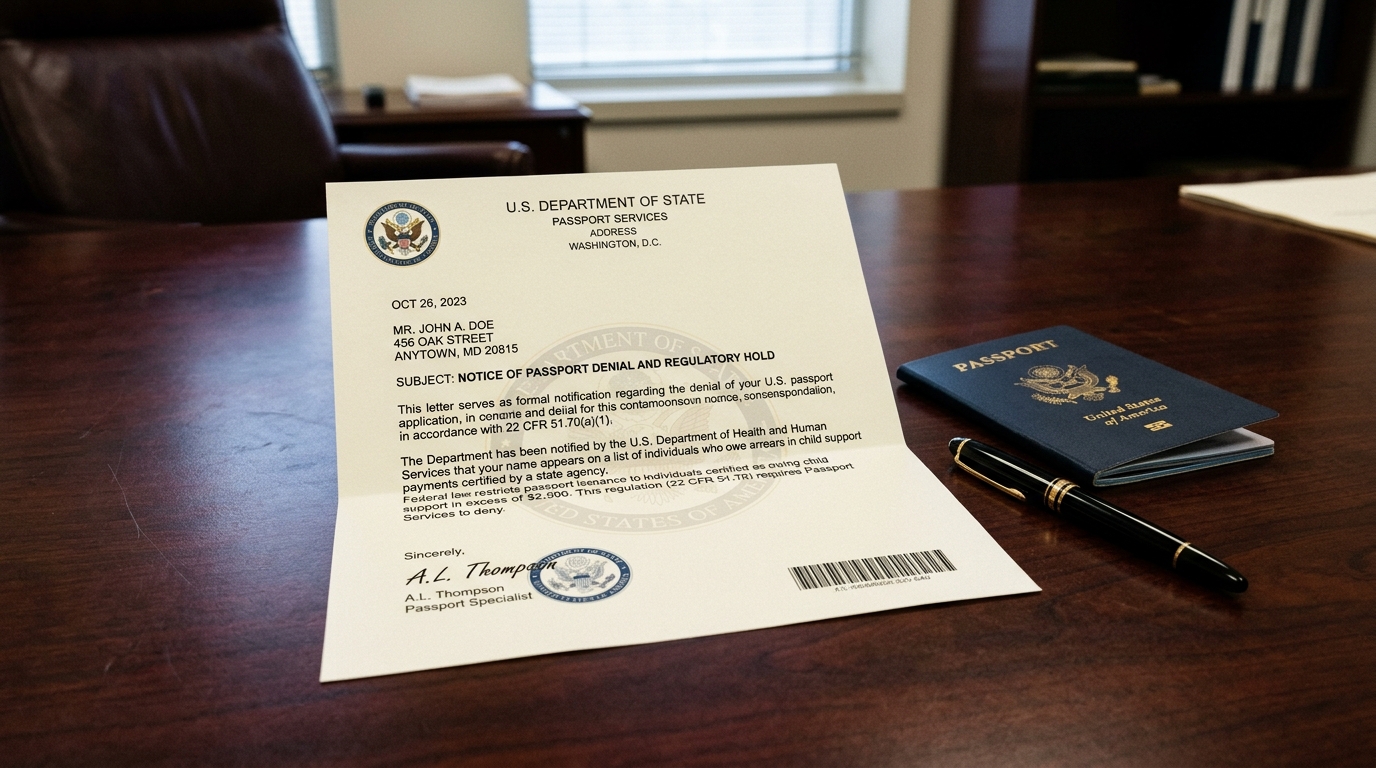
If your passport tracking status displays a suspension or you receive an official denial letter citing child support arrears, execute the following protocol immediately:
Step 1: Contact Your State IV-D Child Support Enforcement Office
Contact the state agency where the support order originates. Determine your exact balance and negotiate either full settlement or an approved formal payment arrangement that qualifies for passport decertification.
Step 2: Make the Required Payment
Submit payment via certified funds (cashier's check, wire, or verified state portal). Request an immediate receipt and confirmation from your state caseworker.
Step 3: State Transmits Decertification Notice to OCSS
The state agency must electronically transmit an updated file to the federal OCSS removing your name from the denial list. Ask your caseworker to mark the transmission as urgent if you have pending travel.
Step 4: OCSS Flushes Federal State Department Hold
Federal database updates typically occur twice weekly. Once cleared in the federal system, your passport adjudication agency can resume processing your book.
4. Critical Timelines: How Long Does Clearing Take?
Travelers should budget between 10 to 21 business days from the date payment clears the state agency until the Department of State's adjudicators verify the release. If your application has been placed on hold, the State Department typically holds your dossier open for 90 days before formally closing and canceling your submission.
4. The Statutory Passport Denial Program (42 U.S.C. § 652(k))
Under the Personal Responsibility and Work Opportunity Reconciliation Act (PRWORA) and Section 452(k) of the Social Security Act (42 U.S.C. § 652(k)), the United States Department of State is statutorily mandated to refuse to issue, renew, or replace a passport to any applicant who is certified by the Secretary of Health and Human Services (HHS) as having child support arrearages exceeding $2,500.00. This statutory denial is codified in passport regulations at 22 CFR § 51.70(a)(8).
The Passport Denial Program operates as an automated inter-agency enforcement mechanism. State child support enforcement agencies submit electronic records of non-custodial parents whose delinquent obligations exceed the federal threshold to the federal Office of Child Support Services (OCSS). OCSS compiles the National Directory of New Hires and continuously transmits this certified debtor list to the Department of State's Consular Consolidated Database (CCD). When an applicant submits Form DS-11 or Form DS-82, the system automatically checks the applicant's 9-digit Social Security Number against this federal hold list.
5. The Multi-Step Administrative Clearance Process
Neither the National Passport Information Center nor consular adjudicators possess the legal authority to negotiate, reduce, or waive child support arrears. You cannot pay child support arrears at a passport agency or acceptance facility. To secure passport release, applicants must execute the following multi-step clearance workflow:
- Identify the Certifying State Enforcement Agency: If multiple states are involved, obtain the specific state agency docket number responsible for placing your name on the HHS hold list.
- Satisfy the Arrearage or Negotiate a Payment Agreement: Contact the state child support agency to pay the delinquent balance in full, or enter into an approved formal payment plan that authorizes passport release under specific state administrative guidelines.
- State Electronic Release Transmission to OCSS: Once payment is confirmed, the state agency must electronically update its records and transmit an electronic deletion request to the federal OCSS database in Washington, D.C.
- Federal Batch Sync to State Department: OCSS processes state deletions and transmits an updated clearance file to the Department of State. This inter-agency synchronization typically takes between 5 to 10 business days.
- Adjudication Hold Removal: Once the applicant's Social Security Number disappears from the electronic denial list, the passport adjudicator resumes processing your application without requiring you to pay new application fees, provided clearance occurs within 90 days of the initial suspension letter.
6. Interactive Frequently Asked Questions: Section 51.70 Child Support
Can I get a temporary passport for a business trip if I owe child support?
No. Federal statutes do not permit business, employment, or vacation waivers. The only narrow exception recognized by federal law involves urgent life-or-death emergencies involving family medical crises, which must be approved by the state child support director directly.
Will my application fee be refunded if my passport is denied under Section 51.70?
No. Under 22 CFR § 51.51, passport application fees are non-refundable administrative processing fees collected to adjudicate your eligibility, regardless of whether a passport is issued or denied.

 alt="Child Support Passport Denial (22 CFR 51.70): Why Arrears Over $2,500 Trigger Automatic Hold & How to Release" style="width:100%; height:auto; max-height:420px; object-fit:cover; display:block;" width="1200" height="600">