Form DS-11: First-Time Adult & Minor Passport In-Person Guide
Complete instructions for submitting Form DS-11 at a post office or acceptance facility, citizenship proofs, and parental consent rules for children.
Quick Answer • Form DS-11 Overview
Form DS-11 (Application for a U.S. Passport) is mandatory for all first-time adult applicants, children under age 16, individuals replacing a lost/stolen passport, or adults whose previous passport expired more than 15 years ago. Form DS-11 must be executed in person before an authorized acceptance agent at a post office, public library, or county clerk. Do NOT sign Form DS-11 until instructed by the clerk.
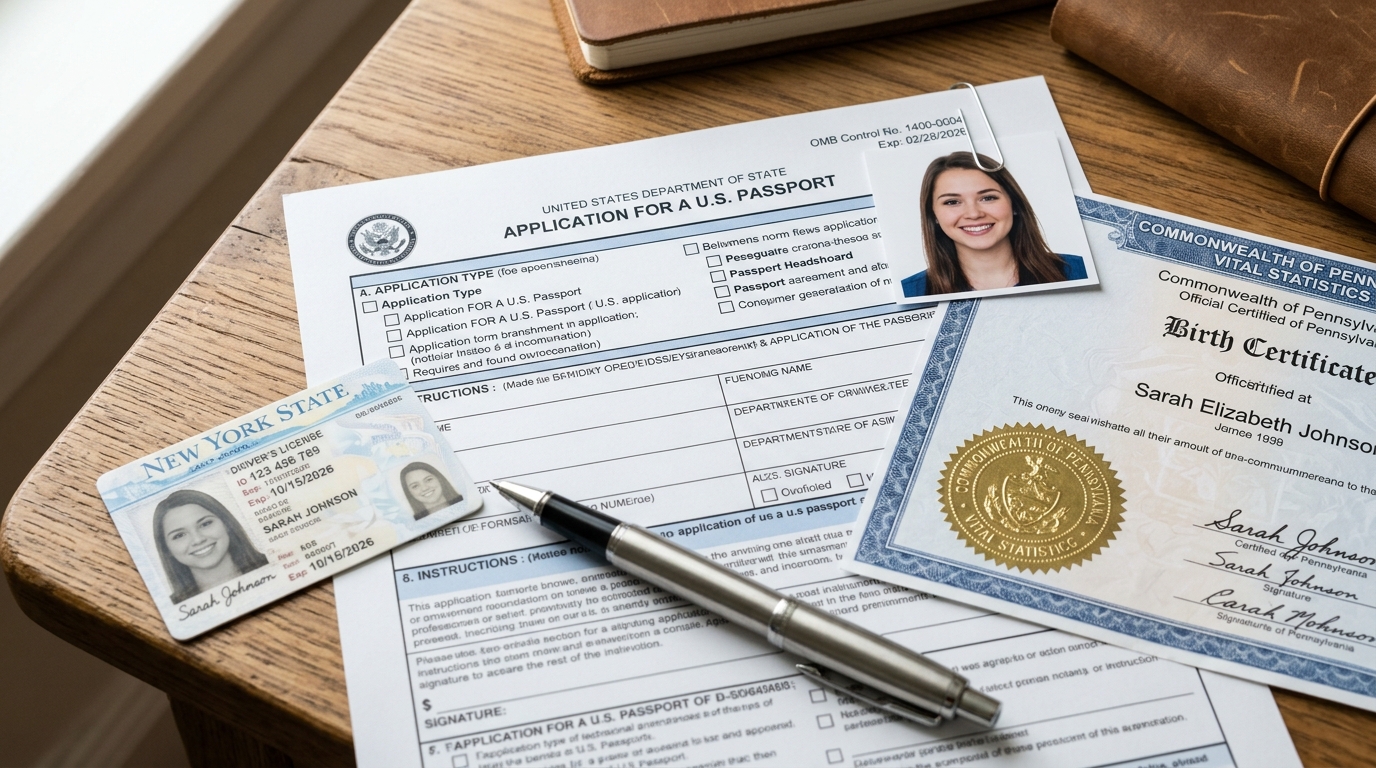
Official Form DS-11 paperwork and citizenship evidence packet required for in-person first-time passport submissions.
Who Must Apply In Person Using Form DS-11?
Applying for your first U.S. passport book or card.
You are under age 16 (Child passport).
Your previous passport was issued when you were under age 16.
Your previous passport was lost, stolen, or mutilated.
Your previous passport was issued more than 15 years ago.
Five Mandatory Documents to Bring to Your Appointment
Unsigned Form DS-11: Filled out online using the barcode form filler or neatly handwritten in black ink.
Evidence of U.S. Citizenship: Certified state birth certificate (with raised seal and parents' names) or original Certificate of Naturalization. Photocopies are not accepted as primary evidence.
Valid Photo Identification: Current in-state driver's license, state ID card, or military ID (plus a clear black-and-white photocopy of front and back).
One 2x2 Inch Passport Photo: Meeting all federal specs (no eyeglasses, plain white background).
Two Separate Payments:
Check #1: Application fee to "U.S. Department of State" ($130 for Adult, $100 for Child).
Payment #2: Execution fee to the acceptance facility ($35.00, payable via card, cash, or money order).
Special Rules for Minors Under Age 16
Mandatory Two-Parent Consent: Under federal law, both parents or legal guardians must appear in person with the child and sign Form DS-11 before the agent. If one parent cannot appear, they must submit a notarized Form DS-3053 (Statement of Consent) accompanied by a photocopy of their photo ID.
Under Section 1 of the Act of June 4, 1920 (22 U.S.C. § 213) and 22 CFR § 51.21, first-time applicants, minor children under age 16, and individuals whose prior passport was lost, stolen, or issued over 15 years ago are legally required to execute Form DS-11 in-person before an authorized passport acceptance agent. Authorized acceptance facilities include designated U.S. Post Offices, municipal clerk of court offices, public libraries, and county registrar facilities.
The core legal principle governing Form DS-11 is the in-person oath: you must present your unsigned application, swear an oath of truthfulness, and affix your physical signature in the physical presence of the acceptance agent after they have verified your identity and examined your primary citizenship evidence.
5. The Two-Check Payment Architecture ($130 + $35)
One of the most confusing administrative aspects of the DS-11 filing process is the requirement to provide two entirely separate payments to two different entities at your in-person appointment:
Payment Purpose
Statutory Amount
Payee Name
Acceptable Payment Methods
Application & Security Fee
$130.00 (Adult) / $100.00 (Minor)
"U.S. Department of State"
Personal check, cashier's check, or money order only. Cash/credit cards NOT accepted for this portion.
6. Interactive Frequently Asked Questions: Form DS-11 First-Time
Can I sign Form DS-11 before arriving at my post office appointment?
DO NOT SIGN Form DS-11 ahead of time. Signing the form before appearing in front of the acceptance agent invalidates the document, and you will be forced to complete a new form on-site.
What primary citizenship evidence must be submitted with Form DS-11?
You must submit an original certified birth certificate (issued by the city, county, or state registrar bearing a raised, embossed, or multicolored seal), an original Consular Report of Birth Abroad (Form FS-240), or an original Certificate of Naturalization / Citizenship. A plain black-and-white photocopy is not acceptable as primary proof.
Are photocopies of identification documents required?
Yes. You must present your valid driver's license or government photo ID AND submit an 8.5x11 inch single-sided black-and-white photocopy of the front and back of that ID alongside Form DS-11.
7. Secondary Citizenship Evidence (When a Birth Certificate Is Unavailable)
Under 22 CFR § 51.42, if you were born in the United States but cannot obtain a certified primary birth certificate because your birth was not registered or vital records were destroyed, you must submit an official Letter of No Record issued by the state registrar of vital statistics, accompanied by certified secondary evidence of citizenship.
Delayed Birth Certificate: Filed more than one year after your birth, supported by early life records.
Early Public Records: Hospital birth records, baptismal certificates, early census records, elementary school enrollment transcripts, or family Bible records created within the first 5 years of life.
Form DS-10 (Birth Affidavit): A formal notarized affidavit executed by an older blood relative (parent, aunt, uncle) who had personal knowledge of your birth in the United States.
Because Form DS-11 requires an in-person oath before a designated acceptance agent, scheduling your appointment at an authorized post office or municipal clerk of court facility requires careful preparation. Due to high national passport demand, many USPS retail facilities book appointments several weeks in advance through the online USPS Retail Customer Appointment Scheduler (tools.usps.com/rcas.htm).
When attending your appointment, bring all documents pre-filled in black ink but completely unsigned. Acceptance agents will inspect each document, verify that your certified birth certificate possesses the registrar's official seal, review your driver's license photocopies, administer the federal oath, and seal the entire packet into an official Department of State tamper-evident Tyvek envelope. Once sealed, the envelope is transferred into the secure postal stream for direct transmission to the federal intake lockbox.