
Certificate of Loss of Nationality (CLN): U.S. State Department Renunciation & Tax Guidelines
Comprehensive legal and consular analysis of Form DS-4083, FATCA citizenship regulations, place of birth compliance, and mandatory passport surrender protocols.
Under U.S. nationality law (8 U.S.C. § 1481), performing an expatriating act does not automatically extinguish U.S. tax and citizenship obligations. Under FATCA and Internal Revenue Code amendments since 2004, the federal government legally treats individuals as U.S. citizens until they formally notify the Department of State, attend a consular interview, and receive an approved Certificate of Loss of Nationality (Form DS-4083).
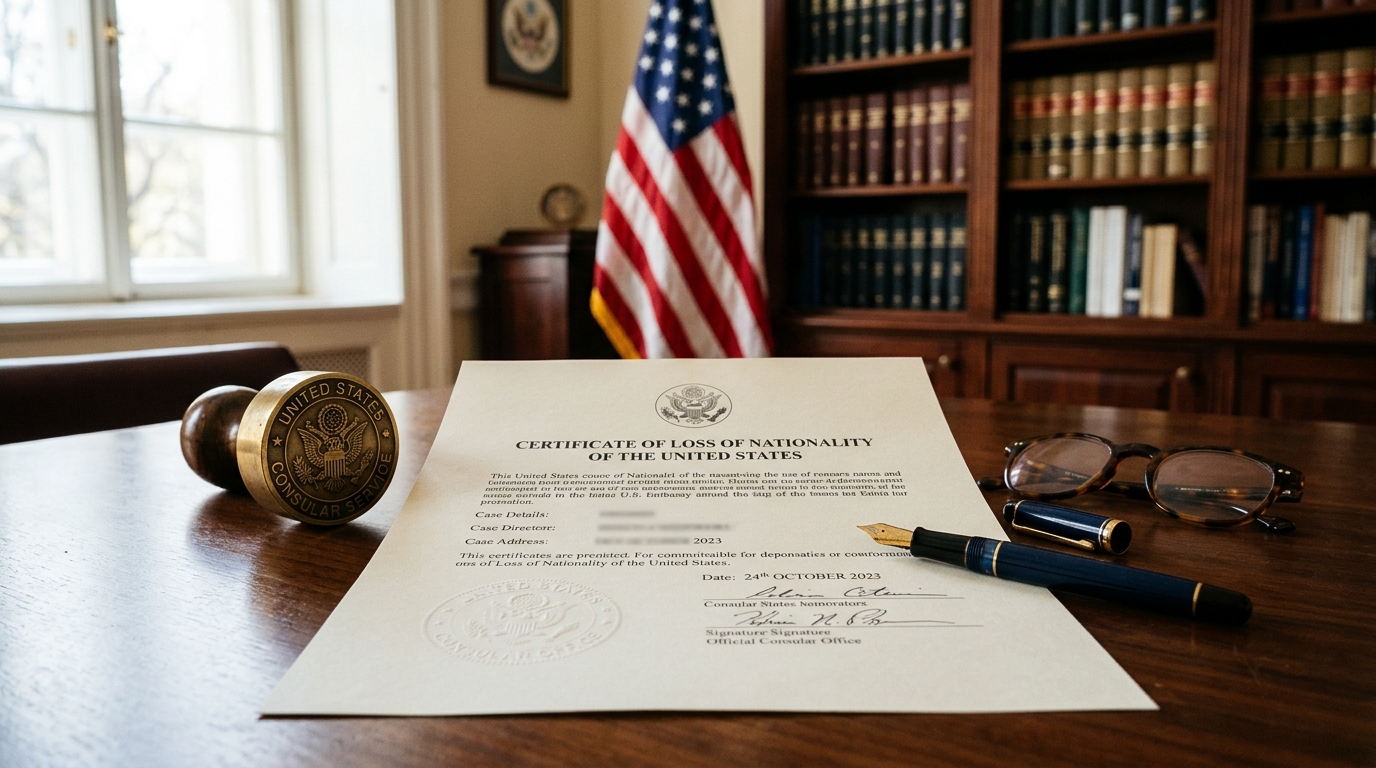
Official Certificate of Loss of Nationality (CLN) documentation and consular legal packet required for formal expatriation.
1. What is a Certificate of Loss of Nationality (Form DS-4083)?
A Certificate of Loss of Nationality of the United States (CLN) is an official legal document issued by the U.S. Department of State under Section 358 of the Immigration and Nationality Act (INA). It serves as conclusive administrative proof that an individual has relinquished or renounced their U.S. nationality pursuant to 8 U.S.C. § 1481(a).
Until a CLN is formally approved and sealed by the Department of State’s Office of American Citizen Services and Crisis Management (ACS) in Washington, D.C., foreign financial institutions and federal agencies are bound by federal statute to treat the individual as an active U.S. citizen.
2. FATCA, 'Accidental Americans' & Place of Birth Issues
Under the Foreign Account Tax Compliance Act (FATCA), foreign financial institutions (FFIs)—including Canadian, British, and European banks—are legally required to report financial accounts held by individuals with a U.S. place of birth. For thousands of dual citizens and individuals born in the United States who moved abroad as infants ("Accidental Americans"), a U.S. place of birth on their foreign passport triggers mandatory account disclosure or potential account freezes unless valid non-U.S. documentation or an official CLN is provided.
Prior to tax law updates in 2004, individuals who performed an expatriating act (such as naturalizing in another country with intent to relinquish) were considered non-citizens under nationality law from the exact moment of the act. However, modern U.S. law specifies that for tax and financial compliance purposes, dual citizens remain subject to IRS worldwide taxation until Form DS-4083 is officially executed.
3. The Consular Relinquishment & Renunciation Process
To obtain a Certificate of Loss of Nationality, an individual must appear in person before a U.S. consular officer at an American Embassy or Consulate outside the United States. The process requires:
- In-Person Consular Interview: The applicant must attend a formal interview where a consular officer confirms that the decision is voluntary and made with full understanding of the loss of nationality.
- Execution of Form DS-4079: Questionnaire Information for Determining Possible Loss of U.S. Citizenship.
- Execution of Form DS-4080 or DS-4081: Oath/Affirmation of Renunciation of U.S. Nationality or Statement of Voluntary Relinquishment.
- Surrender of U.S. Passport: The applicant must physically hand over all current and expired U.S. passport booklets and passport cards to the consular officer.
- Administrative Processing Fee: Under federal schedule (22 CFR 22.1), the Department of State assesses an administrative processing fee of $2,350 for formal renunciation.
4. Mandatory Passport Surrender & Cancellation Protocol
Once your passport is surrendered, you can no longer enter the United States as an American citizen and must travel using your foreign passport with appropriate visa clearance or ESTA authorization.
5. State Department Adjudication Timelines & IRS Form 8854
Once the consular officer reviews the packet at the foreign post, the dossier is transmitted to the Department of State in Washington, D.C. for final legal review and signature. Processing times for the issuance of Form DS-4083 typically range from 3 to 8 months depending on consular post backlogs.
Upon final approval, the sealed Certificate of Loss of Nationality is mailed to the applicant. The applicant must then file IRS Form 8854 (Initial and Annual Expatriation Statement) with their final U.S. tax return to finalize their tax expatriation.